Ralph Orchestrator
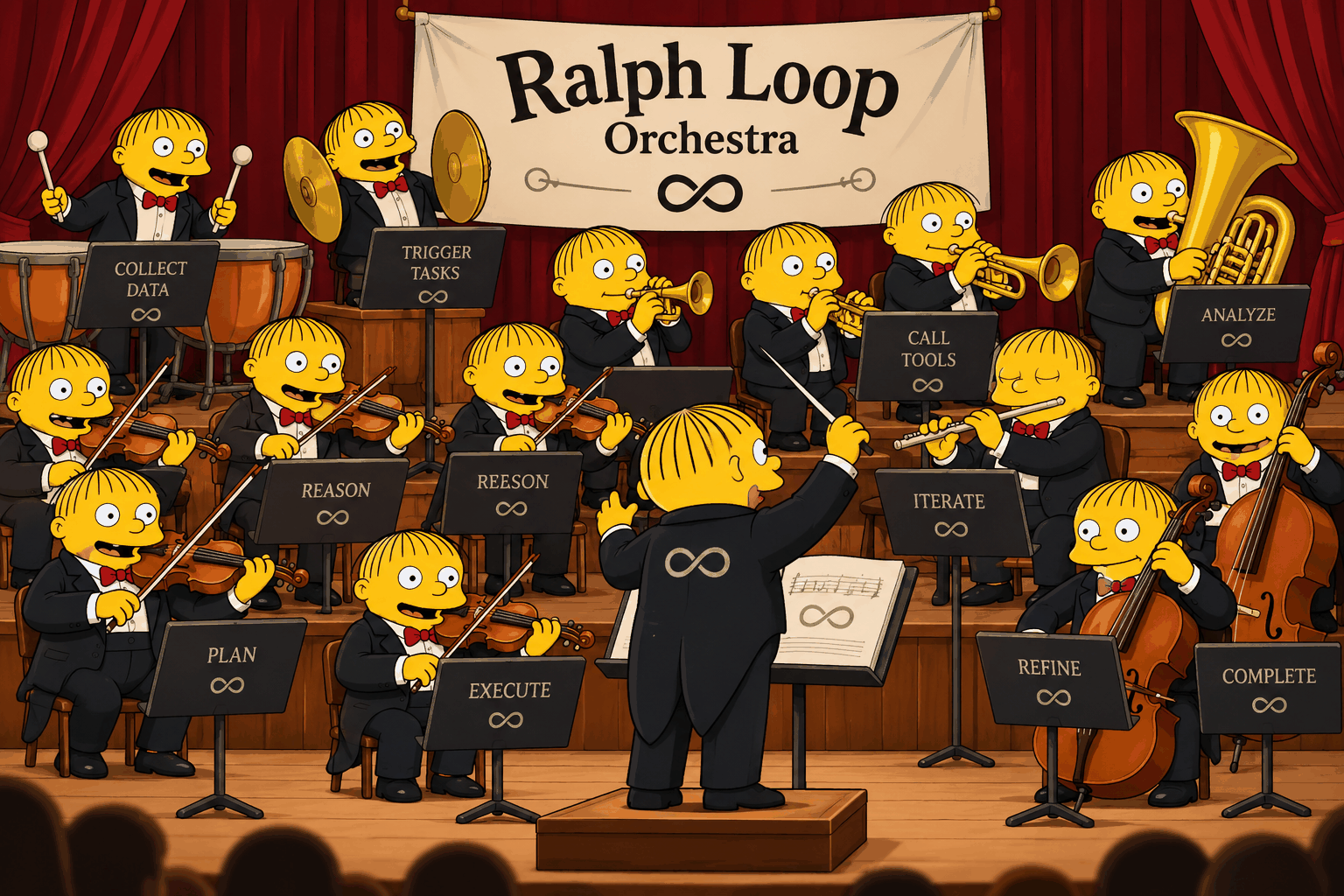
Ralph Orchestrator is a drop-in kit for a git repository. You write what must be true (a specification); the kit turns it into a structured modification plan (a DAG of tickets, each with an executable acceptance command and a file scope) and executes that plan with parallel autonomous coding agents — one git worktree and branch per ticket — merging only what both an independent LLM review panel and each ticket’s acceptance command approve.
The kit is named after the "Ralph loop" (https://ghuntley.com/ralph/): an agent that works in a loop against a completion gate, never self-certifying.
Main capabilities
-
Dependency-aware scheduling — tickets declare
depends_on; the orchestrator runs the ready set with a dynamic agent count (pending tickets weighted by complexity, capped by configuration). Tickets whose file scopes overlap are never run in parallel. -
Completion gate, no self-certification — a ticket merges only when its changes stay inside its scope, its
acceptshell command exits 0 (run by the orchestrator, never the agent), the review panel votes quorum, and the project regression suite passes on the integration branch after the merge (the merge is undone otherwise). -
Independent review panel — several different LLM reviewers vote on each diff (and on interface contracts and change requests). A model never reviews its own ticket.
-
Agent collaboration — parallel agents that never share a context agree on interfaces first (contract negotiation), talk through a file-backed message bus, and can request changes to already-merged tickets (a review panel decides; approved requests become follow-up tickets).
-
E-mail loop — periodic plain-text status mails and a final report with the interactive HTML report attached. Replies to the mail go back into the loop: mentioned tickets receive the reply as feedback, and a reply to a blocked ticket unlocks it. An always-on
watchagent handles the gaps between runs. -
Live dashboard — a dark, self-contained web UI (workflow graph, tasks, agents & models, plugins, start-time × duration timeline) polling the same state file the orchestrator writes, plus a self-contained HTML/PDF run report.
-
Resumable state — everything runs against
.ralph/state.json; a crashed or interrupted run resumes from where it stopped, with real wall-clock event history.
Primary components
| Component | File(s) | Responsibility |
|---|---|---|
Orchestrator (CLI, scheduler, merger) |
|
All commands, the run loop, serial merge into the integration branch, wizard, watch agent |
Worker |
|
One ticket to a reviewed, accepted commit: worktree, agent process, scope guard, acceptance, handoff |
Review panel |
|
Quorum voting on diffs, contracts and change requests |
Collaboration |
|
Message bus, contract-first negotiation, change-request follow-up tickets |
Planner |
|
Specification + repository overview → validated |
State |
|
Resumable run state + structured event recording |
|
Status mails, webhook, reply capture and consumption |
|
Presentation |
|
Shared snapshot document, live dashboard server, optional PDF rendering |
See Architecture for the full component map and runtime data flow.
Supported technologies and standards
-
Python ≥ 3.9. The runtime core (scheduler, worker, state, bus, dashboard, e-mail) is stdlib
PyYAML; LangChain (langchain-core,langchain-openai) is used only for the LLM-backed features (planner, consensus, contracts). -
git ≥ 2.28 (worktrees, branches). All repository state the kit creates lives under the target repo’s
.ralph/directory andout/reports. -
OpenAI-compatible model gateway (base URL templated per model) for the LLM calls.
-
Agent CLI: any command that edits files in its working directory — the default is
opencode run(OpenCode), configured inagent.cmd. -
SMTP (587 STARTTLS / 465 SSL) and IMAP (993 SSL / 143 STARTTLS) for the e-mail loop; optional Teams/Slack/ntfy webhook (JSON
{"text": …}). -
Optional Playwright headless Chromium for PDF rendering of the run report.
Quick start
A two-minute, fully offline demonstration (no models, no keys, no internet — a shell script plays the "AI agent"):
cd mockup/demo-repo
python3 -m pip install PyYAML
./setup.sh
python3 ralph_orchestrator/orch.py run
A real run: install the kit into the repository you want to change, run the wizard, plan, and execute — see Getting started.
Documentation map
-
Getting started — prerequisites, installation, wizard, first run
-
2-minute offline showcase — the mockup demo, verified output, reset
-
Architecture — components, data flow, runtime flow, persistence
-
Component pages: scheduler, worker, consensus, collaboration, planner, e-mail loop, dashboard and report
-
Configuration reference — every
config.yamlkey -
Data models —
tickets.yaml,state.json, bus/inbox/contract formats -
Dashboard HTTP API — endpoints and the snapshot JSON contract
-
Command reference — every
orch.pysubcommand -
Verification and tests — test suite, reproducible checks
-
Maintaining this documentation — build and version the site